





Trump’s blackmail toward European NATO members –demanding they "put their soft hands in their pockets" to sustain the alliance– and his apparent attempts to sideline them by negotiating directly with Russia to end the war in Ukraine had already triggered a reaction and panic within the Western alliance. In our previous article [1], we examined where Trump's administration was heading with these moves, what the recent NATO summit meant in this context, and why there is no end in sight for the war in Ukraine. This time, we will focus on how European imperialists are approaching the same issues.
Following Trump’s provocations, leading EU countries and the UK held summits in the spring to discuss forming an alternative security framework in case of NATO’s collapse and how to sustain military support for Ukraine. Until recently, their priority was stopping Russia in Ukraine. But faced with new realities, European imperialists have now decided to accelerate militarization and arms races to avoid being sidelined in global power struggles and to assert a more dominant role. Reducing this to mere submission to U.S. pressure oversimplifies the issue. War and militarization are inevitable outcomes of capitalism’s historical system crisis. As we will see, Western imperialists increasingly rely on military spending to revive their economies.
The idea of a European Army, which was previously raised by France but rejected by Germany, has been brought back to the table by France in this search for alternatives. After Brexit, France became the EU’s sole nuclear power and permanent UN Security Council member. France, which has long been competing with Germany for leadership within the EU, has used this status to take the lead in the search for alternatives. In particular, it has held summits with EU members under the guise of supporting Ukraine, but it has failed to secure a decision to take steps in this direction at the Munich Security Conference this winter or at subsequent summits. This is because Germany, which has set itself the goal of becoming Europe's largest military power, wants to remain under the umbrella of the US and NATO for the time being! At the last NATO summit, even though all European partners fawned over the US, this does not mean that the contradictions with the US or the fierce competition among themselves have ended. Such imperialist alliances should not be seen as harmonious and permanent entities free of contradictions, but rather as unstable unions riddled with conflict. Both Germany and France –especially since they found themselves threatened with being thrown out of the table in Ukraine!– aim to prove they cannot be ignored. The recent announcement by French President Macron that France will officially recognise the Palestinian state should also be considered in the same context.
The ultimate result of the European imperialists' quest to create an alternative military alliance to NATO was the confirmation of a historical/systemic reality: the impossibility of forming a tight military and political union in Europe, which is home to a number of powerful imperialist countries! It has long been accepted that this cannot be achieved through economic superiority or diplomatic manoeuvres, and the military option has been tried several times. From Napoleon to Hitler, bloody attempts in this direction had always ended in failure, producing nothing but the slaughter of peoples. The fundamental reason why efforts to transform the EU into not only an economic but also a political and military union have been doomed to failure lies in the same historical/systemic reality.[2] The only power capable of uniting Europe militarily under a single roof was the United States, which came from across the Atlantic as a saviour, albeit against the Soviet Union, which was perceived as a threat to the established order!
Defence or war?
Some liberal writers complain that the world has now become "unruly and based on the rule of might" and that "the global legal order has been completely eroded". This observation would be entirely correct if not for the word "now". The capitalist world hierarchy has been based on power from the very beginning. With the two world wars of the 20th century, the United States emerged as the new hegemon of this world, and the rules, institutions, and laws it imposed began to prevail. But this was also the product of the greatest massacre in history, the Second World War; that is, what was at stake was an international system and order determined directly by economic and military power. After the collapse of the USSR, all balances changed, and the international system/order that reflected the balances of the post-World War II era collapsed. Since then, a struggle for hegemony has been waged on a global scale, and this struggle has given rise to a new type of world war. In capitalism, war is the ultimate means of establishing a new international division of power in accordance with changing economic power balances; those who accept capitalism and complain about this situation as if there were any other option are nothing but hypocrites.
All capitalist states carry out their military expenditures under the guise of "defence spending." In their language, the name of the war ministry is the defence ministry, and the arms/war industry is the defence industry! However, if this were true and everyone were really spending these funds for defence purposes, no one would attack anyone else, which would mean that no one would have to spend money on defence. This means that there is at least one aggressor, and at least one of the states claiming to be defensive is lying through its teeth. The truth is that all imperialists and regional powers make these expenditures not to defend themselves against an attack, but to protect or increase their share in the imperialist division of spoils, since war is the ultimate means for this division.
In the capitalist system, there is no end to armament and military spending. This is because military technology is constantly evolving and old systems are becoming obsolete. This in turn creates a necessity to spend anew on the latest weapons technology. If one side develops a new weapon, its rivals are spurred on to develop new weapons to neutralise it. Arms manufacturers always make huge profits; countries that lack the means to develop such weapons (which constitute the majority) are at the mercy of the major powers, dependent on their aid and protection, and are forced into huge debts just to purchase older models of these weapons. In any case, the main burden of arms buildup falls on the working class through increased taxes and reduced social spending.
“Let’s arm ourselves!”
Last year, a staggering $2.7 trillion was spent on military expenditures worldwide. It is worth remembering that this colossal amount could solve many urgent problems humanity faces, such as hunger, famine, lack of water, lack of medicine, epidemics, and lack of schools.
It is well known that the United States leads the way in armament. Not only does it continuously increase its military spending, but it also resorts to various schemes to sell more weapons to others. For example, it indirectly earns trillions from the war it is waging in the Middle East (despite this, some so-called intellectuals seriously claim that the United States does not want war in the Middle East). This is what Trump's return from his trip to the Middle East in May, where he signed a total of $3.2 trillion in arms sales and investment agreements with the UAE, Qatar and Saudi Arabia to be implemented over 10 years, means. This is an outright extortion exacted from them under the guise of defending Sunni dictatorships against Iran. The US is telling these dictatorships, just as it has told Europe, "If you want us to protect you,you must pay the price." The US military has stockpiled weapons at levels unprecedented in the country's history, and a whopping $575 billion will be spent on a new air defence system called the "Golden Dome."
NATO chief Rutte is no less guilty than Trump in inciting armament. In statements made prior to NATO's summit in The Hague, Rutte said that Russia poses a threat and that this threat will continue even if the war in Ukraine ends. He emphasised that "we must be a stronger, more lethal alliance," that air and missile defence must be increased fivefold, and that "thousands of armoured vehicles and tanks and millions of artillery shells" are needed.At the last NATO summit, they got all members to agree to spend 5% of their GDP on military spending, with Trump by their side. European Commission President (i.e., the head of the EU government) Von der Leyen also keeps saying that "peacethrough strength" is the way to go and that Europeans “need to spend much more" on their own defence.
The British government, which says that "the Russian threat cannot be ignored," also announced plans to increase its military capacity at the beginning of June. According to these plans, six new ammunition factories will be built, 12 nuclear submarines will be constructed, and £15 billion will be invested in the "independent nuclear deterrent," i.e., the nuclear weapons programme. Last year, the British Chief of the General Staff said that "we must be ready for war within three years." The German Chief of the General Staff also made similar statements, saying that Russia is arming itself very quickly and will be able to attack NATO countries within four years at the latest, fuelling Russia paranoia.
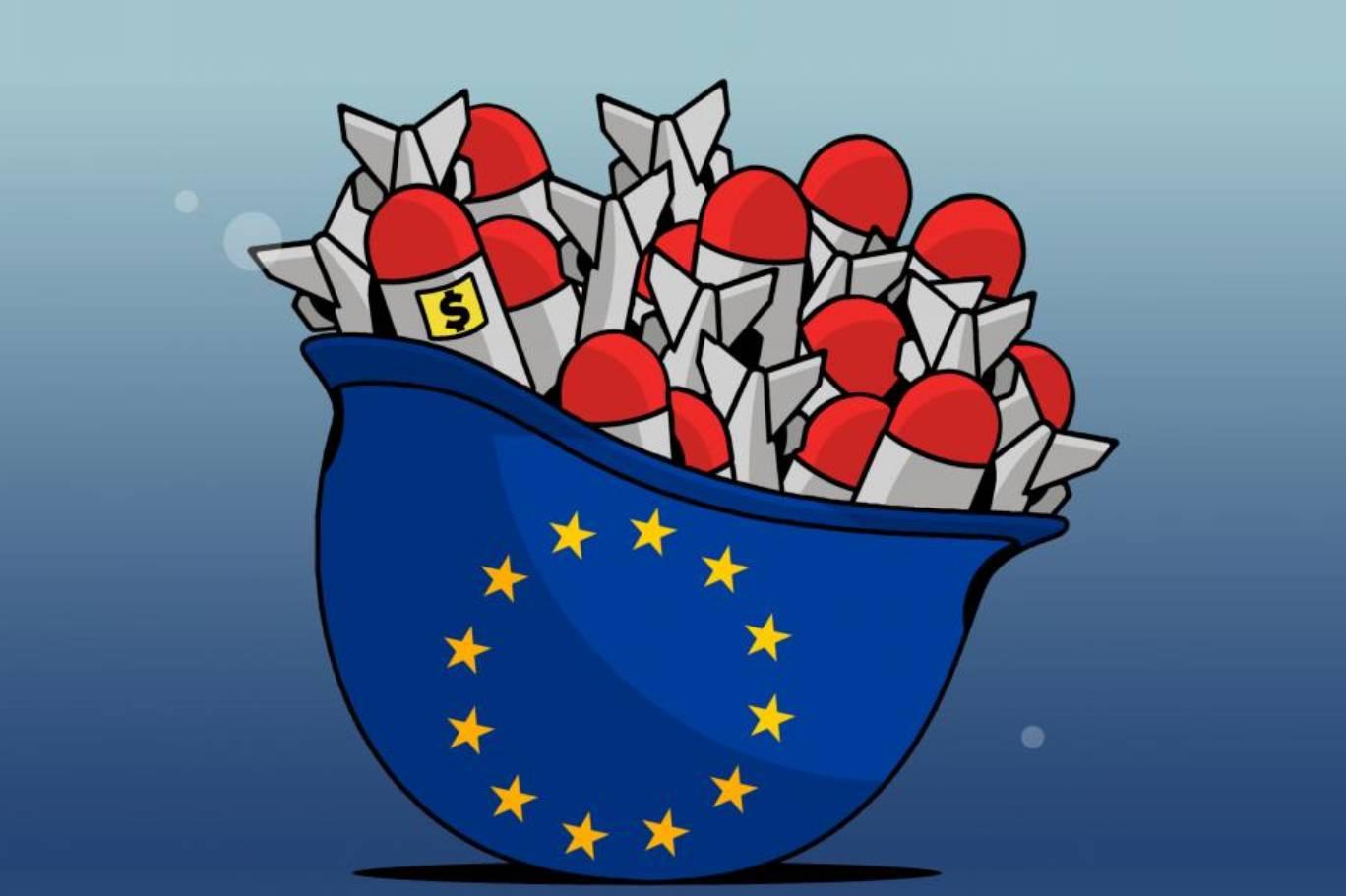
The EU adopted a plan titled "ReArm Europe" in March 2025. Following objections from some countries to this name, the plan was renamed "Readiness 2030”. Under this plan, up to 800 billion euros in financial resources will be mobilised across the EU for rearmament in the coming years.[3] In this context, budget rules will be relaxed, existing EU funds will be redirected towards military spending, and the private sector will be encouraged to invest in the arms industry. In this context, the European Council, composed of EU heads of state and government, approved a 150 billion euro fund for joint arms production and procurement by the end of May. The fund will be named the Security Action for Europe (SAFE).[4] Major arms manufacturers, particularly German companies, are rubbing their hands in anticipation of securing large orders through this programme. When compared to the total military aid of 62 billion euros provided by the EU to Ukraine over the past four years, the scale of these figures becomes even more evident! [5]
As can be seen, all EU and NATO countries are increasing their military spending. However, the fact that Germany, which has twice been at the forefront of the forces that have ravaged Europe in history, is once again rapidly embarking on military buildup holds particular significance. This situation carries the potential to further fuel a world war and create new developments or cracks within imperialist alliances.
Germany's accelerating militarisation
Germany's new chancellor, Merz, added that the top priority on their agenda is to "provide all the financial resources needed to make the German Armed Forces the strongest conventional army in Europe," saying: "The lesson is simple: Power deters aggressors, weakness invites aggression. (...) We must become such a powerful Germany and Europe that we will not be forced to use our weapons." To this end, Germany must "assume more responsibility within NATO and the EU." According to him, this is what Europe expects from Germany!
It is clear that Germany wants to extend its financial and economic leadership within the EU to the political/diplomatic/military sphere in order to close the military gap with its main rival, France. In this direction, a constitutional amendment was passed in Germany in recent months, loosening the "debt brake" and approving a 500 billion euro debt package for strengthening the war machine and military infrastructure spending.[6] This package alone accounts for more than half of the EU's project mentioned above. The social-democratic defence minister describes this as "more military units, more equipment, and greater readiness for military operations," but does not mention that all of this reflects a desire to escalate the war.
In June 2023, Germany announced its first National Security Doctrine. This doctrine aims to respond swiftly to developments such as bloc formation and multipolarity in the international arena. China was described as an anti-democratic, authoritarian power that uses its economic strength as a means of coercion, while Russia was identified as the greatest threat. The goal is for Germany to take advantage of developments to gain "geostrategic roomfor manoeuvre" and become "one of the leading actors in shaping the global political climate." The document identified increased "defence spending”, modernisation of the armed forces, and military personnel reinforcements as key elements of "defence policy”.
Despite opposition from the majority of the German public, the ruling elite is calling for the reinstatement of compulsory military service, which was abolished in 2011. We also know that these calls are not limited to Germany. Florian Hahn, the European Union's spokesperson on defence policy, has also called forthe reintroduction of compulsory military service in EU countries "by the end of the year."
In recent years, there has been a growing tendency to overcome the intractable stagnation with measures known as "military Keynesianism”. Deutsche Bank has announced that facilities belonging to the shrinking automotive industry should be transferred to the arms industry. This is not limited to Germany; in other countries as well, metal plants that have closed due to the crisis are being considered for conversion into arms production facilities. Increased military spending by the state means higher tax burdens on workers, cuts to their social rights, and deteriorating living and working conditions.
"Europe that has forgotten war"
For many years, the people of Europe were lulled into believing by their rulers that war was a thing of the past. While various parts of the world were engulfed in war, the impression was created that neither war nor its consequences would reach European soil. Even the wars and suffering in the Balkans in the 1990s were not seen as Europe's problem, but rather as an extension of the issues caused by the collapse of the Soviet Union.
Today, the situation has completely changed. Millions fleeing wars in Africa and the Middle East have poured into European countries, hoping to survive and carrying their suffering with them.[7] Then, the Ukraine-Russia war shattered all notions of peace. Now, bourgeois governments in European countries are attempting to legitimise their militarist policies and programmes of attacks on labour by highlighting the threat of war and invasion, in stark contrast to the previous period.
The European front of the world war is currently affecting only the eastern part of the continent directly. Capitalist powers want the war to remain confined to areas where the struggle for division is taking place, far from their own territories. However, both because of the uncertainty about what will actually happen and to drive their populations into panic, bourgeois governments are taking various steps. For example, in recent years, the public in Germany and some Scandinavian countries has been repeatedly advised to build shelters in their homes and stockpile food if possible. Recently, a decision was made in Germany to convert tunnels, metro stations, underground car parks, and basements of public buildings into shelters. Apparently in a hurry, they claim that this method can quickly meet the need rather than building new shelters.
The paranoia of a Russian invasion being fuelled
EU leaders have created a paranoia that "we could be invaded at any moment." By instilling fear and panic in their populations, they seek to legitimise their militarist policies and increased military spending, as well as their desire to spread the Third World War. Europe's military and political leaders are constantly calling for preparations for an "impending war." The threat they refer to is none other than Russia, which has been demonised since the start of the Ukraine War. Russia is portrayed as a country waiting for an opportunity to invade and then annex European countries. This project is no different from the past when Saddam's Iraq and the mullah regime in Iran were presented as threats to the Middle East and a lot of noise was made about them. Yet it is the Western imperialists who, by violating agreements, encouraged the former Soviet republics to take a stance against Russia and join NATO, thereby provoking Russia. A few years ago, they cornered Russia on the issue of Ukraine, dragged it into a war of attrition, then isolated and demonised it. One of the consequences of this was the elimination of Russia's influence in Syria and the transformation of that region into a sphere of influence for Western imperialists (led by the United States).
Western imperialists are now playing a similar game in the Caucasus. The US-Israel and the EU are provoking Azerbaijan against Russia (and also against Iran), encouraging it to distance itself from Russia and move closer to the West. Azerbaijan wants to seize the Zangezur Corridor, which connects it to the Nakhchivan Autonomous Region. This is one of the reasons why it is positioned against Russia and Iran as well as Armenia. The close cooperation and trade established with Israel in recent years and its ambitions towards the territories in northern Iran, where Azeris are in the majority, can also be considered the main reasons for the tensions with Iran. On the other hand, Turkey, which positions itself as supposedly opposed to Israel, is becoming a partner of Israel through its deep relations with Azerbaijan. Armenia, another arena of imperialist rivalry, has also seen increasing tensions in its relations with Russia and a growing tendency to shift towards the West, especially since the recent war with Azerbaijan. The coup attempts targeting pro-Western Prime Minister Pashinyan are an expression of the rivalry between major imperialist powers. Thus, once again, the power struggle in the Caucasus is intertwined with the ongoing war of division in the Middle East.
These facts expose the lies of Western imperialists. But this does not mean that Russia is fighting a just war when we look at the other side. It is clear that Russia is also an imperialist country and that it acts on the basis of imperialist interests in the wars it has been involved in, from Ukraine to Libya and Syria. From this perspective, Russia is just as much an enemy of the working class as the US or the EU. However, contrary to the lies of Western imperialists who portray themselves as freedom-loving and peace-loving while portraying their rivals as aggressive, there is no concrete evidence that Russia currently intends to invade and then annex Eastern Europe.
In fact, when we consider the fundamental characteristics of imperialism, we see that the major imperialist powers of our time do not pursue a policy of conquering new territories or seizing the territories of their rivals. Today, there is no rational basis for any major imperialist power to pursue such a policy of conquest and annexation. For colonial wars and large-scale annexations of territories in non-neighbouring regions (such as overseas territories) are long gone. This does not mean that annexation will never happen again, of course. Capitalist powers, large and small, are always on the lookout for opportunities to seize control of historically unresolved, disputed regions that are close to them and neighbouring them. This will always be the case. However, although imperialist world wars may involve all forms of occupations and annexations, it is important to remember that imperialism is not an (internal or external) colonial empire, but is based on the division of the world not in terms of territory, but essentially in terms of spheres of influence. Today, the major imperialist powers consider it sufficient to have regimes that are economically, politically and militarily dependent on them in their spheres of influence, and to be granted important economic and military privileges in exchange for political alignment with them in the global axes. Russia's current stance reflects this approach as well. It is striving to maintain its relations with the former Soviet republics in Belarus, the Caucasus and Central Asia on this basis.
From what has been said so far, it is clear that not only the United States but also other major Western imperialists are seeking to further spread and escalate the ongoing World War. Russia and China, on the other side, see where things are heading and are preparing accordingly. It is very clear that the only thing the imperialists, plunderers and militarists will bring is more death. They are not pursuing peace, but rather more influence and more power. According to them, peace can only come "after the great victory"; until then, more weapons, more soldiers, and more powerful attacks will be needed. The people will be asked to make greater sacrifices and to unite tightly around the state in defence of the homeland. Those who pin their hopes for peace on the great powers, their negotiations, or international bourgeois institutions are deceiving not only themselves but also the world's workers. The truth is starkly clear: The only force capable of stopping the imperialists is the organised revolutionary working class.
[1] Oktay Baran, NATO Summit, Ukraine War, Imperialist Blocs, 19/7/2025, https://marksist.net/node/8557
[2] For details of this discussion, see: Elif Çağlı, A Marxist Approach to the European Union Issue, April 2003, https://marksist.net/node/506
[3] https://www.indyturk.com/node/757582/haber/avrupanın-yeniden-silahlanma-serüveni-rearm-europe-nedir
[5] Trump repeatedly claimed that the US was ahead of the EU in supporting Ukraine and repeated the falsehood that the EU's aid was in the form of loans. However: "Europe has surpassed the US in its contributions to Ukraine. Europe has provided 70 billion euros in humanitarian aid and 62 billion euros in military aid, while the US has provided 50 billion euros in material and humanitarian aid and 64 billion euros in military aid." (https://www.indyturk.com/node/753970/dünya/5-maddede-münih-güvenlik-konferansı)
[6] A rule added to the Constitution after the 2008 crisis limited the government's annual net borrowing to 0.35% of GDP. The amendment exempted military spending from this debt brake.
[7] According to the "2025 Peace Report" prepared by a group of academics in Germany, more than 122 million people worldwide have been displaced from their homes due to wars, primarily in Ukraine, Gaza and Sudan.
link: Oktay Baran, European Imperialists and Militarist Ascendancy, 26 July 2025, https://en.marksist.net/node/8575