








It’s evident from many recent events how quickly analyses based on the rhetoric of bourgeois politicians become meaningless. Just a few months ago, with Trump’s announced tariffs, the nonsense about the end of globalisation was repeated not only in the bourgeois media but also in the socialist media. We, on the other hand, rejected such assessments and pointed out that Trump was trying to dictate agreements to his rivals through blackmail and bluffs. This bargaining process continues with both agreements reached and points still unresolved.
The same flawed approaches and methods are widespread today in discussions about ongoing wars, imperialist alliances, and NATO. Both bourgeois commentators and some socialists who dedicate themselves to journalism don’t hesitate to base their analyses on the daily statements of bourgeois leaders. However, there is a huge gap between appearances and the underlying reality, especially in the field of bourgeois politics. In many cases, bourgeois politicians don’t shy away from stating the exact opposite of their intentions. Therefore, instead of listening to everything that’s said, the most accurate approach would be to evaluate concrete actions, if any, within the framework of the general character of the period. Otherwise, one not only makes mistakes but also becomes a tool in the deception and manipulation operations of bourgeois politicians.
In fact, in his first presidential term, Trump had already pulled the plug on NATO countries, and then comments such as “NATO is over” and “the Atlantic Alliance is over” flooded the airwaves. Then, during the Biden era, these discussions lost their sway, relations with Europe were strengthened again, and the ongoing Ukraine-Russia war led to a stronger alignment of EU powers behind the US. After Trump’s second ascent to the presidency, his and his running mate’s repeated statements about European security and NATO —this time linking them to the war in Ukraine— were met with panic by European NATO members. Since the beginning of this year, EU leaders have met multiple times to discuss how to create a new security umbrella. Their statements openly expressed their distrust of the US. Following this, many bourgeois commentators and academics once again began writing about the end of US-EU cooperation and alliance, the demise of NATO, and so on. In other words, the method we criticized above once again stirred up a lot of dust. These exaggerated, hasty, and sensational comments, consciously made by journalists/commentators due to professional concerns, bring to mind the words of the famous American writer Mark Twain, who, annoyed by rumours stemming from his illness, mocked the press by saying, “The reports of my death are greatly exaggerated.”
With the NATO summit at the end of June, it became clear how hasty such comments were. The Trump administration, which has been bluffing Europe since the winter of this year (in fact since his first presidential term), got what it wanted from this summit. The pressure on the European countries to actually foot the bill for the military expenditures of NATO and the Western alliance, to increase military expenditures and to procure a significant part of their weapons from the United States has reached its goal.
In this context, we think it would be useful to briefly recall and comment on the problems that have come to the fore during the past months. Because similar developments will continue to take place in the coming period.
What does the US want from NATO members?
The Trump administration is telling Europe “I will no longer provide your security for free”. As is well known, American imperialism, which emerged as the undisputed hegemon of the capitalist world after World War II, also assumed the protection of the capitalist world against the USSR in return for the acceptance of this position. It was both the primary founder and the largest power of the NATO alliance and by far the biggest financier of its military expenditures. During the Cold War, while the USA was engaged in an escalating arms race with the USSR, many European countries, being under the security umbrella of NATO, did not engage in the same arms race and diverted their resources to other areas.
The relations between the US and the European imperialists were strained following the collapse of the USSR, and the US hegemony began to be questioned by the EU countries (primarily Germany). In that initial period, these imperialist states were engaged in a veiled struggle in the Balkans, the Caucasus and some African countries. This clash ended with the EU countries (essentially Germany and France) accepting that they couldn’t break US hegemony under the conditions of that time. In this process, the USA launched a new war of hegemony and re-division in order to re-consolidate its questioned and shaken dominance, and to preemptively block potential new rivals. On this basis, NATO was reconstructed, the role of the US as a big brother over its Western allies was reaffirmed, and Russia and China were identified as common rivals and enemies.
As a consequence of the ongoing wars it wages, the US is continuously forced to increase its military expenditures. Today, it’s essentially emphasizing to its old allies that if they wish to remain allies, they need to dig into their pockets. The US is reminding them that they can no longer continue to have a say in the world’s troubled regions for free, nor can they demand free protection against threats posed by common rivals. Indeed, under the conditions of capitalism’s historical crisis, we see that the US no longer wants to bear the economic cost of such an expensive imperialist “big brother” role. The US has blackmailed its Western allies, telling them: “Either forget the security umbrella provided by NATO, or pay for it.” It showed them death to make them accept fever. This is the essence of the tension and storm created by the Trump administration.
Last NATO summit
Actually, back when the “NATO is over” debate was flaring up, US Vice President J.D. Vance had made his intentions very clear to NATO Secretary General Rutte: “NATO is a critically important military alliance, and we are its most important part. But we also want to ensure NATO is structured for the future, and for us, the most important part of that is NATO taking on more of the burden in Europe so that the US can focus on some of the challenges in East Asia.” These statements very clearly lay out the US approach: lighten our military and financial burden, and allow us to focus on East Asia!
One cannot know for sure what will happen tomorrow, but today, as yesterday, the Trump administration has no intention of disbanding NATO.[1] On the contrary, it favours its continuation under its own patronage, but wants NATO’s costs to be borne by the other member states. He demands that the member states increase their military expenditures and continue to receive the necessary weapons and ammunition from the United States.
Even though Trump boasts about “carrying NATO’s burden alone” and demands contributions, the reality is that the NATO alliance is of great importance to the American arms industry, let alone its other dimensions. Let’s not forget that the USA is the world’s biggest arms exporter. The value of its arms exports last year was 320 billion dollars, an extraordinary amount, which is 10% of the total US exports. In 2020-24, its share in global arms exports increased compared to the previous five years, from 35 per cent to 43 per cent. In this new period, the largest customer was by far the European countries with a share of 35 per cent.[2] The reason why Europe has overtaken the Middle Eastern countries to take the first place in the list of customers is the tension caused by the war in Ukraine and the fact that they were constantly blackmailed in this direction by Trump in the previous period. During this period, arms imports by NATO countries in Europe doubled over the previous period, and the share of arms imports from the United States rose from 52% to 64%. Therefore, for the US to leave the EU to its own devices would mean that the US arms industry would irreversibly lose a major customer, a situation that neither the military-industrial complex nor the Trump administration, which it supports, can easily afford.
During his first presidential term, Trump wanted NATO members to increase their military spending to 4 per cent of their GDP (the existing rate was 2%, with discussions about raising it to 3%). At the time, however, the vast majority of NATO members could not even meet the current 2%. This time Trump raised the stakes even higher and insisted on 5%! Yet, even the US spending rate last year was around 3.4%.
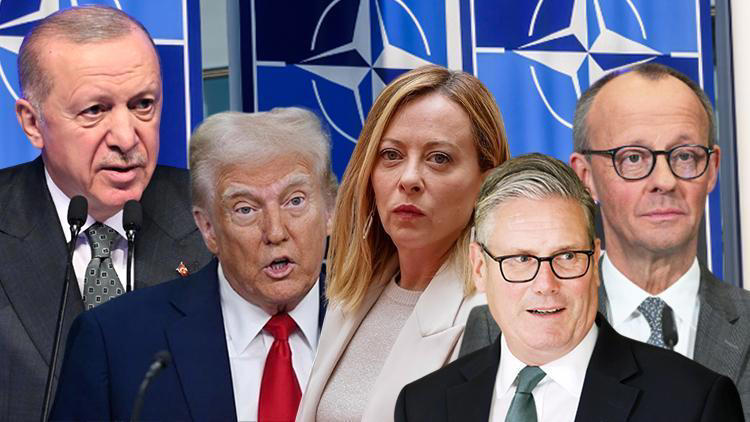
As the last NATO summit showed, the pressure exerted by the US, through Trump, on its NATO partners with various bluffs has been reciprocated. At the summit, it was decided that by 2035, member states would allocate 5% of their gross domestic product (GDP) to “defence and security” spending. Accordingly, NATO members will spend at least 3.5% of their GDP directly on “defence” needs (personnel, equipment, operations), while the remaining 1.5% can be used for “counter-terrorism” and military infrastructure investments. In this context, the construction or overhaul of military-critical infrastructure such as ports, railways and bridges will be financed by the state. According to one estimate, close to 1 trillion euros will be spent in this direction within ten years. The US will take the lion’s share of this. After all, it is the American arms industry that supplies the EU countries with weapons, especially the most modern weapons and ammunition. In the last decade, the US arms sales to NATO member states have grown by 30%.
Another remarkable thing about the summit was that, unlike in the past, the question of the war in Ukraine was not at the top of the agenda this time. Moreover, for the first time in the last four years, the final declaration did not mention Ukraine’s NATO membership or the war going on there.
We can see from the decisions taken in NATO that the way out of the economic recession is to increase military expenditures. But when we take into account the world war we are going through, it becomes clear that the issue is not only to create an economic revival. NATO is eager to expand and enlarge the current war. The fact that all US demands were met at the summit should also be interpreted as the consolidation of its hegemony over its NATO partners. Those who interpret the results of the summit as a preparation for a new great war fail to realise that that war is already in progress. What needs to be determined is that the ongoing world war is wanted to be enlarged, expanded and deepened.
Another unnoticed fact about the summit is that the leaders of the NATO member states are in a race to flatter Trump in the face of his pressures. Some have dubbed this “praise diplomacy”. Let us quote a short excerpt because it is striking. Just before the start of the NATO summit, NATO Secretary General Rutte sent a short message to Trump in which he said the following, which Trump posted on his personal social media account “Donald, congratulations and thanks for your decisive action in Iran. It was truly extraordinary and something no one else would have dared to do. It makes us all safer. You are on your way to another great success in The Hague!” Rutte continued in the same vein during and after the summit: “Unique”, “great achievements” and “victorious” leader, “father of the house”! The leaders of Germany, Italy, the United Kingdom and even France are not far behind Rutte; they are all trying to work out how to manage a megalomaniac. Trump isn’t saying “I feel like a king” for nothing! It’s clear that with the decay of capitalism reaching its extreme, the rise of leaders like Trump has also sounded the death knell for classical bourgeois diplomacy and decorum.
Ukraine war
Although there is no mention of the war in Ukraine in the NATO final declaration, Ukraine remains a front where NATO forces are actually waging war against Russia. Of course, this war also involves a struggle for hegemony.
Even before the war in Ukraine, there was a hegemony struggle between the USA and Russia-China. It is necessary to see the war in Ukraine as a part of the world war fuelled by this hegemony crisis. It would be absurd to take Trump’s remarks against Zelenski that “you should never have started this war” seriously, because it was US imperialism that actually fuelled the Ukrainian war. Although Trump is now trying to blame the Democrats for the war, this was not the case. Not only the Democrats, but the entire top of American imperialism was in favour of provoking this war. It was Britain and the US that encouraged Ukraine in this direction. At this point, however, there are tactical differences between Trump, who now has the support of a majority of Republicans, and the Democrats (and the EU countries) on the approach to the war in Ukraine and to Russia. The Trump administration wants to end this war, which it considers to have fulfilled its mission, by extracting concessions from Ukraine. According to them, it has fulfilled its mission because this war has kept Russia busy and cornered, put it on a path that will rapidly deplete its resources, isolated it from the Western world and distanced it from the Middle East.[3] The US now wants to focus on the Iran and China problem as soon as possible.
It’s not hard to guess that a negotiation is underway to cede the occupied territories in Crimea and Eastern Ukraine to Russia, in exchange for Russia accepting regime change in Syria, not getting involved in Libya, and not supporting Iran too much. In order to achieve this compromise, the US administration has also taken remarkable steps, from rebuking Zelensky on live TV to vote against the motion in the United Nations Security Council for “Russia to withdraw from the occupied Ukrainian territories”. On this basis, by threatening to cut off military and financial support, the US has forced Ukraine to make concessions both to the USA and to Russia. Although Ukraine emerged from this pressure with a very lucrative mining deal for the USA[4], it has so far been unable to force Ukraine to submit to Russia’s occupation. The EU and the UK are filling the vacuum in terms of support and are encouraging Ukraine to continue the war as before. Under these circumstances, Russia is also continuing the war, frustrating the US initiatives. In other words, on this front, the Trump administration has not achieved exactly what it wanted.
Another goal that the US wanted to achieve by appearing to get closer to Russia was, if it could, to drive a wedge between China and Russia.[5] US Secretary of State Marco Rubio confirmed this on 25 February when he said that the US aimed to weaken the ties between Russia and China. He said that it was not good for Russia to be China’s partner, “because we are talking about two nuclear powers allied against the United States”. He also emphasised that they want to block the global trade network that China is building, the Belt and Road Initiative.[6]
However, it is not at all easy for US imperialism to get results from such attempts to drive a wedge between China and Russia. Both the economic relations that Russia has developed with China and the unity of “mentality” between them (let us remember that North Korea provides direct military support to Russia on the same basis) constitute serious obstacles at this point. Moreover, after the collapse of the USSR, both during the Yeltsin era and in Putin’s early years, Russia wanted to reconcile and get closer to the USA. Their demand was that the US and NATO should stop encircling Russia. But despite the compromises and agreements reached, American and British imperialism broke their promises. Instead of forming a partnership with Russia (although Germany made some efforts in this direction for a while), they wanted to bring it to its knees. With the “coloured revolutions” they tried, and are still trying, to detach the components of the former USSR from Russia’s sphere of influence. Russian imperialism gave its first reaction in Georgia. When the Western imperialists did not stop and provoked Ukraine, the present war broke out.
It should be noted that China has turned the sanctions and embargo imposed on Russia due to the Ukraine war into a great opportunity for itself. Chinese companies quickly filled the void left by the withdrawal of Western companies from Russian territory after the war. Russia sells its rich raw material resources, especially oil, natural gas and some rare elements, to China at very low prices. In this way, China gains an advantage over the US, among other factors, through low input costs. The trade volume, which was 110 billion dollars in 2019, reached 245 billion dollars in 2024. Within this, the cheap oil that China buys from Russia accounts for a quarter of this volume. China also meets Russia’s need for advanced technology, especially chips. There is both co-operation and competition (as in any great power alliance) between Russia and China. After the collapse of the USSR, Russia could not recover for a long time and its influence over the former Soviet Republics weakened. With Putin’s Bonapartist rule, Russia started to become a global power again, setting its sights on its former spheres of influence and making significant progress in this regard. However, China’s economic investments and influence in the Turkic republics in Central Asia have recently increased considerably.
Let us summarise. The Trump line, in fact, in line with the general line of American imperialism, is based primarily on the reduction of China’s position as a global economic power and preventing it from becoming a global political/military power. At this point, Trump is making tactical attempts to drive a wedge between Russia and China, to neutralise Russia and to make the necessary concessions. If he fails to achieve his goal with these tactics, it is quite possible that he will take the opposite course and increase the dose of violence and war and legitimise this transformation as “look, you see, I did my best to compromise, but they rejected it, leaving us with no other choice”.
[1] When analysing Trump’s statements, we must bear in mind that they also cause discomfort within the US ruling class, since the Pentagon’s statements can be diametrically opposed to his.
[2] The other largest buyers were Saudi Arabia (12%), Ukraine (9.3%) and Japan (8.8%).
[3] Attributing this line to Trump’s long-standing relations with Russia and the fact that Russian capital has long supported Trump’s property projects reflects an overly idealistic (leader-first) understanding of history.
[4] Thanks to this agreement, “we now have access to a very large quantity of very high quality rare earth elements,” says Trump. It seems that Trump’s threat/bluff/blackmail method has worked on this issue, as on many others. With the agreement, all of Ukraine’s underground riches became available to the United States (exploration, extraction and processing); American companies received concessions and priority of use/purchase over these resources.
[5] There is a reverse example of a similar initiative in history: While the USSR was the main rival, US President Nixon organised an official visit to China in 1972, after which tensions between China and the USSR increased further.
link: Oktay Baran, NATO Summit, Ukraine War, Imperialist Blocs, 19 July 2025, https://en.marksist.net/node/8557